Thursday, August 23, 2012

"The Books of Abarat" by Clive Barker (Part One)


Hands up: who likes novels with pictures in them?  I don't mean pictures at the beginning of each chapter, those little sketches at the tops of the pages or whatever.  And I also don't mean a color plate or full-page black-and-white every fifty pages, with a relevant line from the story to put it in context.  No, I mean a picture a page (or even more frequent than that), with the words zig-zagging out of the way to avoid them.  Full-color illustrations that really give you a reference point as to what the author really means when he describes a new character or setting.  Now imagine a book like that, except it also weighs about 2 pounds because those gorgeous pictures (and words) are printed on glossy, photo-paper-thick pages.  That's the Abarat series by Clive Barker. 
The first three or four times I read the original book, Abarat, it would not stick in my head.  I knew I had read it before - there aren't very many other books so heavy and full of color - but I could not remember the plot details.  There was girl protagonist, I knew, ordinary young Candy who finds her way to the extraordinary world Abarat.  The setting was unique: an archipelago consisting of 25 major islands, one for each hour of the day (and one extra), which exist permanently within that hour no matter how long you linger there.  I could remember the story up to the point where Candy is swept up by a strange sea and taken from the middle of Minnesota to a seething, vibrant, totally alien culture where she somehow fits right in - but after that, nothing.  I read this book four times, and each time the story was practically new to me.

I've gotten to the point now where I can recall the plot with a little thought, and I think I understand now why I had such an issue doing so in the past.  Abarat is structured a little like a dream, with similar logic.  Neil Gaiman has mentioned that dreams make terrible stories because "Dream logic isn't story logic. Transcribe a dream, and you'll see. Or better yet, tell someone an important dream  - and watch their eyes glaze over."  Yet in this book, it almost seems to work.  The plot is surreal, but it's not all-over-the-place enough that you can't figure out what's going on.  Candy does some island-hopping, enjoying or suffering brief encounters with very, very strange creatures.  The diversity of the world is intense, and you get the feeling that the author is barely scratching the surface when he introduces the myriads of species that Candy meets.  It's a world that is very clearly full, rich, vibrant, and most importantly, complete.  Instead of reading about a world, you feel like you are exploring it, and that when you turn the corner, whatever is there has always been there - it wasn't just made up to advance a story or provide a twist.  And isn't that how you feel in dreams, a little bit?

Side note: Barker began this series with the illustrations, with the plan of a book of short stories called "Book of Hours."  Allegedly, when he realized the pictures were suggesting a more complex story, he changed his approach and turned them into a novel.  Let me just say, I really like this.  I love the idea that pictures inspired the story, and that feels like the key to my appreciation of the first book.  At the risk of foreshadowing my own review, I'll say that the plot of the series worked much better when the pictures dictated it than when the author actually sat down and thought up the story on his own.  The organic feeling of art inspiring story is what makes Abarat so special to me.  


The book ends with a lot (A LOT) of storylines unfinished and questions unanswered, but not in, like, a "LOST" sort of way, where you're disappointed and left thinking, "But what just happened?"  Which brings me to...the sequels!
.........
That was part one of my review of "The Books of Abarat."  Part two will be along within a week because it's taking too dang long to write.  :)

Friday, July 13, 2012

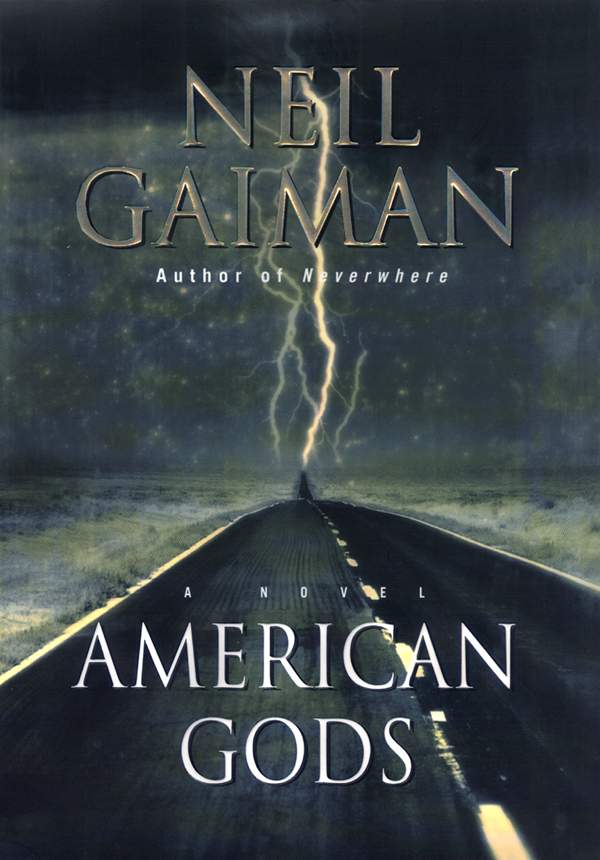
American Gods by Neil Gaiman


Comfort food: that very personal, very specific dish (or dishes) that makes you feel good when you’re upset, that you crave when things are going poorly, that makes an unfamiliar place seem a little more like home.  I’ve got mine, and I’ve also got the literary analog to comfort food.  “Comfort book” sounds a little strange, but that’s what it is.  And what that book is, is American Gods by Neil Gaiman.  (I’ve also got a comfort movie, “Spirited Away,” but of course this is a book blog and I won’t go there right now.)
I read American Gods every three months or so.  I can't seem to help myself - I'm drawn to it like no other book I own.  I was the type to read the Harry Potter series from start to finish every summer, so this re-reading of books is not new for me.  There’s something about American Gods that’s different, though.  I get something new out of it every time I read it.  Maybe it’s a line I somehow didn’t catch before, or a joke that just now makes sense, or a piece of foreshadowing that finally clicks into place.  But no matter what, the fact remains that every time, every time, I find something new, and that keeps me returning to the novel. 
When someone sees me reading and asks, “What are you reading?” I like to sum it up by genre first, then plot summary if they seem interested.  For instance, if I was reading A Game of Thrones, I’d characterize it by saying, “It’s the first in a fantasy series, like ‘The Sopranos’ in medieval times.”  Or Twilight (gods forbid) would be, “A vampire romance novel for teenagers.”   I can’t be nearly as concise or precise for American Gods.  The best I can get out is, “It’s like, sort of fantasy but set in the real world, kind of sci-fi but without any science – okay, there’s gods and they’re living in America because all the settlers and immigrants brought their beliefs from other countries, expect America is a bad place for gods so they’re starting to die from lack of worship, so they're trying to stay relevant and fighting for their spiritual survival.”
Maybe the best genre label for it is “modern mythology” (which isn't a real genre at all, although it should be).  Shadow, the protagonist, is released from prison after serving three years for an arguably justified crime; with no prospects and little to live for, he is hired as a bodyguard for a self-proclaimed con-man calling himself “Mr. Wednesday.”  It soon becomes clear (very soon, for readers well versed in world mythologies) that Wednesday and the other characters Shadow encounter are not humans, but gods.  Anansi, Anubis, Kali, and many other ancient deities make appearances (I won’t name-drop any more of them, for risk of spoiling some plot points).  The main thrust of the story is this: these old gods, who were carried to the New World in the minds and hearts of their worshipers, are being forgotten, while new gods – those of the Internet, plastic surgery, highways, and television – are gaining strength and threatening to push them into extinction. 
Beyond that, the book is alternately exciting, terrifying, disturbing, amusing, thought-provoking, and poignant, with enough twists and side-plots to keep you guessing and entertained.  It’s a sweeping novel that covers the entire continental United States.  It would make an incredible mini-series, as long as said series had a huge budget for travel and location shooting, not to mention special effects.  It’s too in-depth and expansive to be a movie, though.  As a side note, I don’t subscribe to the idea that books are just ideas waiting to be turned into movies.  It’s just that American Gods is incredibly cinematic already, and I think the right screenwriter could make it into a very good, very faithful-to-the-book mini-series.  That screenwriter, of course, would be Neil Gaiman himself, who has plenty of experience writing for film and TV.
Speaking of TV, let’s talk about casting the characters in this story.  Gaiman’s writing tends to not focus on the appearances of his characters, and it’s sometimes hard to pin down what they look like.  In American Gods, the gods are expertly described, probably because they depend so much on their images and how people perceive them.  Shadow’s physical description, however, is relatively vague and not addressed in detail (oh, I get it, he’s a shadow, so it’s hard to tell what he looks like! rim shot).  He’s a big guy - that’s pointed out about every ten pages.  He is mistaken for many different races by different people, mostly based on those people’s biases.  He is alternately asked if he has Hispanic, African-American, Native American, and Romani ancestry, but he never acknowledges any of these as part of his lineage.  His skin color is once described as “coffee-and-cream,” and his mother suffered from sickle cell anemia, seeming to indicate that she was African-American.  His father was European-American, and that’s all I’m going to say because his father’s identity is a plot point.  In any case, Shadow is hard to cast in my mind.  Gaiman says he pictures Shadow as looking like Dwayne Johnson.  I, on the other hand, picture him as a buff, dark-skinned version of Gaiman.  And if you know what Neil Gaiman looks like, you’ll understand how strange a juxtaposition those words are.  

See?  See how weird that would be?
It might seem a little odd that a British writer could write a novel about America that is so spot-on to the spirit of dysfunction and pride of this country.  To be fair, Gaiman has lived in the U.S. for many years now.  Also, this story is about America – it’s not about the United States.  It’s about the land and the minds of the people who live here, and about how we think about the land and each other and ourselves.  Mr. Wednesday has some great lines about the unique and contradictory qualities of America.  “This is the only country in the world that worries about what it is…The rest of them know what they are. No one ever needs to go searching for the heart of Norway. Or looks for the soul of Mozambique. They know what they are."  And: “San Francisco isn’t in the same country as Lakeside [Wisconsin] anymore than New Orleans is in the same country as New York or Miami is in the same country as Minneapolis…They may share certain cultural signifiers—money, a federal government, entertainment—it’s the same land, obviously—but the only things that give it the illusion of being one country are the greenback, The Tonight Show, and McDonald’s.”
I mentioned comfort food earlier in the context of introducing this book.  When I spent a semester in Ireland this past fall, this was the only book I brought with me initially (I didn’t want to weight down my luggage).  It was a good choice: I went through a pretty rough first month of culture shock and homesickness.  Having a book set in my home country, with a protagonist who is out of his depth but still manages to make the best of very confusing and upsetting circumstances, made things easier for me, at least while I was reading it. Because of that, I read the book four times in the four months I was there, and it never got old.  If Shadow can deal with gods and still keep going, I reasoned, I can learn an unfamiliar course schedule and get used to people driving on the left side of the road
Neil Gaiman is my favorite writer, and I’ll most likely create other posts about more of his books.  I’ll close with a line that typifies not only Shadow’s attitude when exploring this new side of America, but also a theme that appears without fail in Gaiman’s writing: dream logic, and making your way through the world as best you can without really knowing what the rules are.
“I feel,” Shadow told her, “like I’m in a world with its own sense of logic.  Its own rules.  Like when you’re in a dream, and you know there are rules you mustn’t break.  Even if you don’t know what they mean.  I’m just going along with it, you know?”

Saturday, June 9, 2012

The Dead Zone by Stephen King

I consider myself a superficial fan of Stephen King - not because I don't like his stuff, but because I don't think I can call myself a "big fan" when the number of his works I've read can be counted on one hand.  I like him for The Shining, The Stand, and The Dead Zone, for the New England identity and persona of his stories, and our shared love for the Boston Red Sox.  If that's not the definition of superficial, then I need to get a new dictionary. 

I'm not a horror junkie and I don't like being scared.  This should, right away, steer me clear of Stephen King.  I actively avoid some of his most well-known stories (Carrie, IT, Pet Sematary) because I'm just not interested, thank you very much.  I don't watch the movies made of his books, at least not before I head to Wikipedia to check out the spoilers so I know I can handle them.  That's why I really appreciate when King deviates from standard horror and goes a little more subtle.  And I read and re-read the heck out of that kind of book.  Case in point: The Dead Zone.

I found my copy of The Dead Zone on a "free books" rack outside a bookshop in Clarksburg.  It's in the condition often described as "well-loved" and sometimes "ratty."  I've read it before - my parents have an impressive King collection at home - but it's always nice to pick up a good old book for another run-through.  This time around, I was struck by the ordinariness of the horror elements.  It's not the kind of book that makes you scared to turn out the lights - it's the kind that makes you shudder and thank God you don't have the terrible talent the protagonist suffers.  If you read The Dead Zone and can get through it without seriously thinking about the implications, you're reading it wrong. 

Some other thoughts.  This book was originally published in 1979; thirty-two years later, King published 11/22/63.  King claims he had the idea for the latter novel in 1971, and it's clear he couldn't avoid shaping certain elements of it during the writing of The Dead Zone.  It's that old chestnut that every sci-fi writer must address at some point: If you could hop in a time machine and travel to 1932, would you try to kill Hitler?  It doesn't have to be Hitler in every scenario.  In The Dead Zone, it's a madman politician with the potential for causing a worldwide nuclear holocaust.  In 11/22/63, it's Lee Harvey Oswald.  Without revealing any spoilers (though really, it's been long enough, you ought to know what happened by now), I want to comment on the similarities and differences between the books. 

Johnny Smith of The Dead Zone has a psychic flash predicting the dreadful future and must decide whether he should, or even if he can, prevent it.  In 11/22/63, the future has happened and passed, and President John F. Kennedy is assassinated, with all that the tragedy entailed; it's a matter of Jake Epping trying to change the past with the foreknowledge gained by experience.  There is no indication for Johnny whether his choice was the right one, except his other psychic experiences that proved to be completely valid.  In the case of preventing JFK's assassination, as with many other stories that tackle the Hitler Question, Jake discovers that hindsight is never simply 20-20.  The two novels point out that there is a difference between changing history by being in it and changing history after it has become set.  That's another reason, I think, why The Dead Zone is a horror story and 11/22/63 is an alternate historical fiction (how's that for a unique genre).  It's an adventure to travel in time, but we never realize that we're always traveling in time - we only travel in one direction.

More thoughts.  I don't watch the movies made out of King's works, but I watched this one.  A young Christopher Walken is incredible in the role of Johnny Smith, and Martin Sheen scares the crap out of me as the crazy politician Greg Stillson.  As I read the book this time, though, I can't help but picture Johnny as a spitting image of David Tennant as the Doctor.  Come on, a tall gangly man with a terrible responsibility who goes by John Smith?  It's too much to ignore.

Finally, an explanation.  I love talking about the books I read, but most of my friends aren't interested in sitting down and listening to me go on and on.  This blog will be for me to get my thoughts out there, and I don't really care if nobody reads it.